
Sphinx
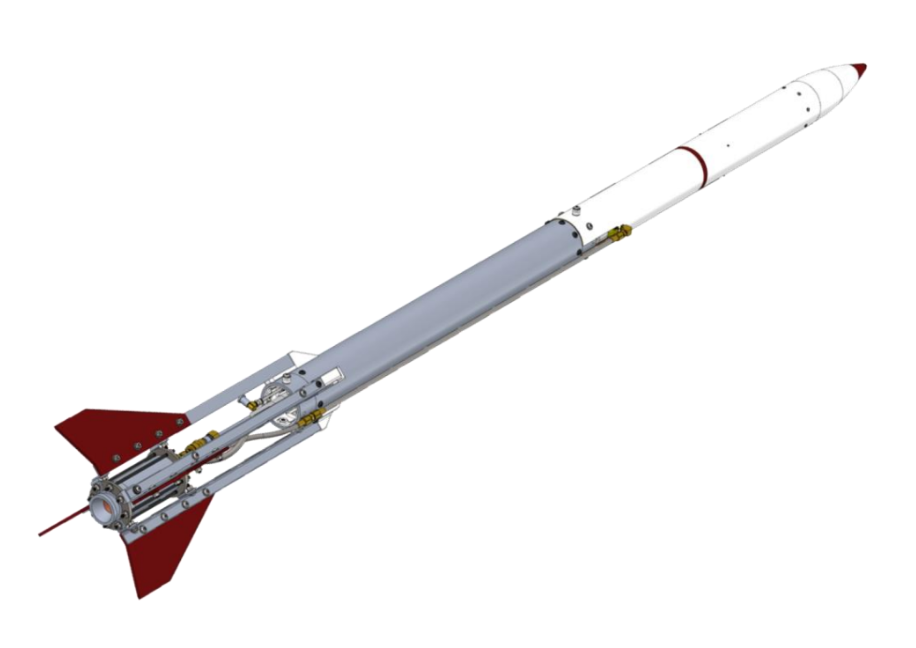
Sphinx is Rice Eclipse’s flight-optimized liquid bipropellant rocket engine. Based on the Mojave Sphinx architecture originally designed by Half Cat Rocketry to minimize costs and increase accessibility, Sphinx has been adapted by our team to serve as our primary flight engine. It acts as a critical steppingstone, allowing the club to rapidly expand our knowledge of liquid rocketry and develop rigorous, flight-ready procedures for future launches.
Performance & Architecture
Engineered for the strict weight requirements of flight, Sphinx operates at the upper end of high-power rocketry. It is designed to produce an average thrust of 250 lbf over a 5-second burn time, delivering a total impulse of 5000 N·s—placing it exactly at 95% of the L-class motor limit. To minimize mass, the thrust chamber and nozzle are precision-machined in-house from lightweight 6061 aluminum stock. To survive the extreme heat of combustion, the engine features a custom-machined 110 copper alloy throat insert. While this copper throat is expected to experience rapid erosion during the burn, our custom MATLAB and NASA CEA thermomechanical models confirm that this approach safely manages thermal stress without requiring a heavy, complex active cooling jacket.
The Propellant Feed System
Unlike our ground-tested engines that rely on active nitrogen pressurization, Sphinx utilizes a highly simplified, single self-pressurizing blowdown system. This feed architecture uses a moving aluminum piston inside a single propellant tank to separate the liquid nitrous oxide oxidizer from the fuel. As the nitrous oxide naturally vaporizes and expands under its own vapor pressure, it drives the piston downward, simultaneously feeding both propellants into the combustion chamber. This elegant solution eliminates the need for heavy external pressurant tanks, complex plumbing networks, and active valves, making it ideal for a lightweight flight vehicle. Furthermore, Sphinx is highly versatile and capable of running on a variety of fuels, including ethanol, kerosene, isopropyl alcohol, and even WD-40.
Manufacturing & Testing Achievements
The team has made massive strides in bringing Sphinx from a CAD model into reality. We have successfully completed the in-house machining of major engine components, turning raw 6061 aluminum stock into precision tank bulkheads, dynamic propellant pistons, casing interface rings, and the core thrust chamber assembly. Custom fluid components, such as the male and female quick disconnects, alongside the precision copper throat insert, have also been fully fabricated. On the testing and safety front, the team has meticulously developed detailed Standard Operating Procedures (SOPs) and extensive Failure Modes and Effects Analyses (FMEA) for both hydrostatic proof testing and static hot fires. To safely capture thrust data during these tests at the South Annex, we also engineered a specialized aluminum restraining ring system designed to safely transfer the engine's massive axial shear loads directly into a centered load cell.
Looking Forward
Looking forward to the rest of this year, the team is heavily focused on finalizing the engine's integration into our fiberglass rocket airframe. With manufacturing wrapping up and our custom flight simulations optimized in OpenRocket, we are aiming for rapid reusability across multiple static hot fires to perfectly dial in our launch and recovery procedures. Ultimately, our overarching goal this year is to safely launch and recover Sphinx, cementing Rice Eclipse’s capability to field a high-performance, fully integrated liquid bipropellant vehicle.