
Prometheus
The Prometheus engine is Rice Eclipse’s program to design, develop, and test the team's first-ever liquid bi-propellant rocket engine. Prometheus uses ethanol as its fuel and nitrous oxide as its oxidizer. Designed primarily as a ground test engine to be fired at the South Annex, Prometheus produces a nominal thrust of 100 lbf over a 5-second burn time. Featuring a copper alloy thrust chamber with active regenerative and film cooling, the engine serves as a foundational testbed to gather useful cooling data and establish reliable liquid propulsion systems for the team's future use.
Performance & Architecture
As a major leap forward from our solid and hybrid systems, Prometheus is designed to produce 100 lbf of nominal thrust over a 5-second burn, yielding a total impulse of 500 lbf·sec. The engine operates at a chamber pressure of 400 psia with a nominal O/F (oxidizer-to-fuel) ratio of 3:1—a parameter specifically reduced from earlier designs to help manage the extreme heat.
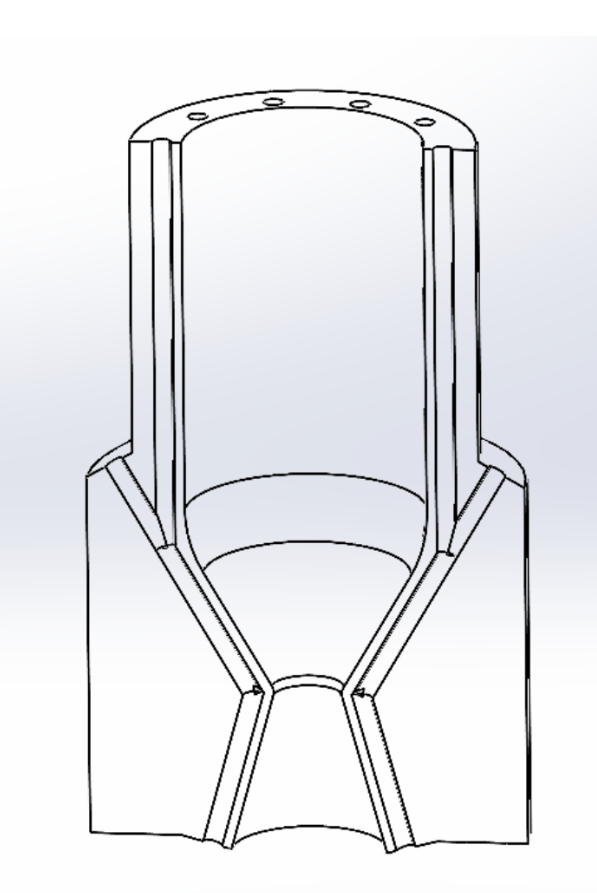
To survive intense chamber temperatures reaching 2722 K (4900 °R), the thrust chamber is custom-machined in-house from c11000 copper alloy. This specific alloy was chosen over others (like c17200) for its exceptional thermal conductivity (360 W/m^2-K) and superior machinability. The chamber features a 2mm wall thickness (providing a factor of safety of 2 against startup transient pressures) and a conical nozzle design with a 12.08 mm throat. The conical geometry was intentionally chosen over a bell nozzle to simplify manufacturing and enable the engine's complex continuous cooling jacket.
Injector Design
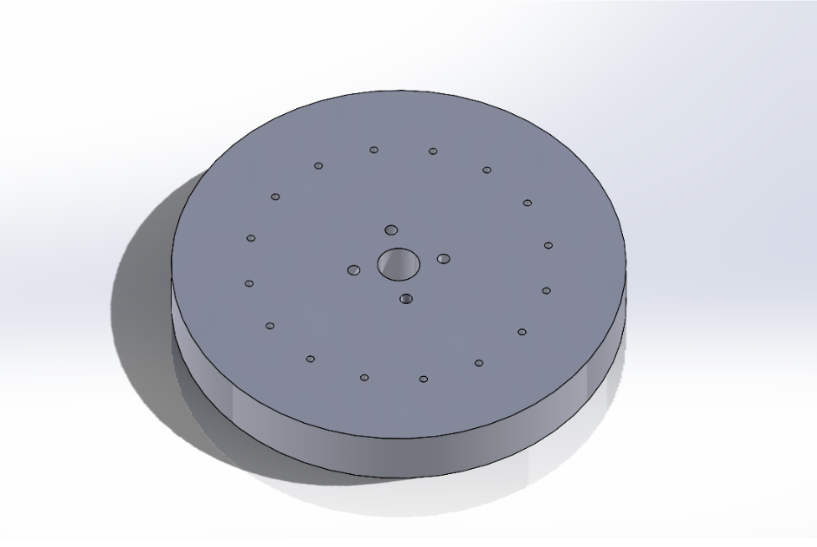
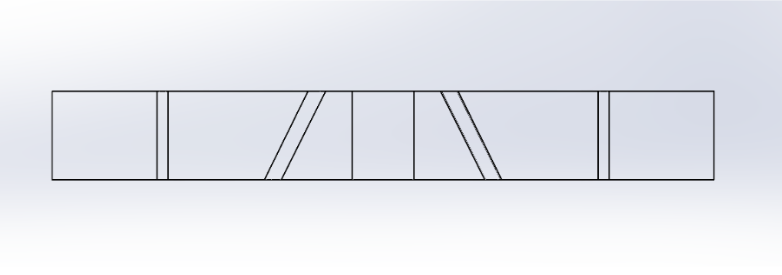
At the heart of the engine is a quad-impinging injector plate. This configuration concentrates the propellant mass flow in the center of the chamber. By keeping the nitrous oxide oxidizer flowing through the middle, the design significantly reduces the likelihood of dangerous oxidizer streaking against the chamber walls. The injector plate also features dedicated holes along its perimeter to introduce axial film cooling. Because it is designed for ease of manufacturing, the team can easily iterate and test new injector configurations in future test campaigns.
Advanced Engine Cooling
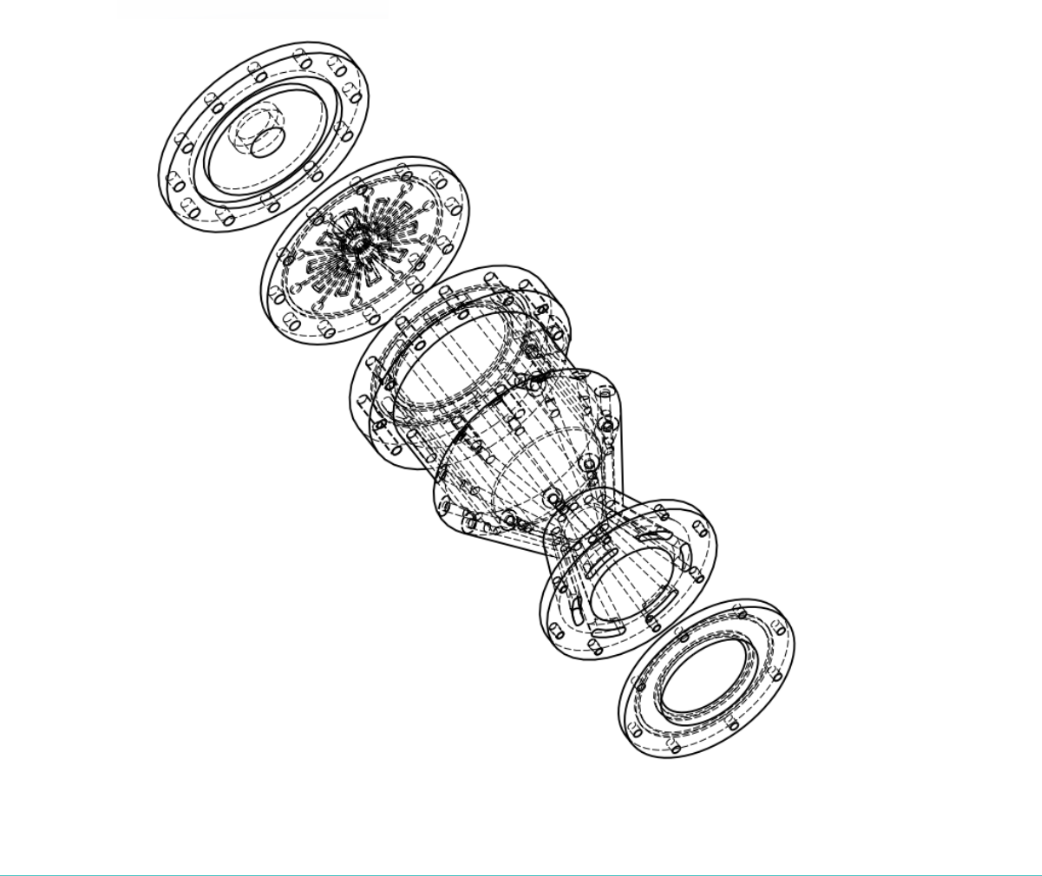
To properly manage the extreme heat flux of a liquid bi-propellant engine, Prometheus employs both regenerative and film cooling techniques. The engine features a continuous, circular cooling channel routed around the outside of the chamber, capped and connected by a manifold. Ethanol fuel is pumped through this jacket before combustion, absorbing heat from the copper walls and keeping the fluid below its critical temperature while maintaining the hot-wall temperature below a safe 750 K limit.
In addition to regenerative cooling, Prometheus utilizes axial film cooling injected directly from the injector plate. Initially, a high percentage of the total mass flow (roughly 25%) will be dedicated to this protective film layer. As steady-state temperature data is collected during hot fires, the team plans to scale back this percentage to optimize engine performance.
The Propellant Feed System
To supply Prometheus with fuel and oxidizer, the team designed a robust propellant feed system heavily inspired by the reliable oxidizer systems used on past projects like Proxima. Rather than relying on self-pressurization, both the ethanol and nitrous oxide tanks are actively pressurized to 800 psi using nitrogen gas. Safety and control are at the forefront of the feed system's design. The plumbing architecture incorporates engine isolation valves that seal the engine from the feed lines during purging operations, alongside feed valves that carefully control the supply of fuel and oxidizer to the engine. To maintain a safe testing environment, purge valves allow the flow of nitrogen gas through the feed lines to clear residue and check for leaks prior to ignition, while check valves are installed throughout the system to prevent any dangerous fluid backflow upstream.
The Test Stand & Electronics
To safely conduct hotfires at the South Annex, Rice Eclipse engineered a dedicated, anchored rocket test stand specifically for Prometheus. Extensive structural analysis—including custom Python load-path models for the top plate, bottom plate, and catch plate components—ensures the stand can safely withstand the engine's axial loads and transient pressures. Data acquisition and launch control are driven by a custom "LabJack Mission Control" electronics suite, which securely handles everything from valve actuation to sensor recording during dress rehearsals and live fires.
Software & Simulation
The entire Prometheus system was developed using industry-standard engineering tools. The team leveraged NASA CEA and Rocket Propulsion Analysis (RPA) for thermodynamic baselines, custom MATLAB scripts for calculating fluid pressure drops and heat flow, and SolidWorks coupled with ANSYS Fluent 3D for extensive fluid and thermal simulations of the combustion wall.
Looking Forward
This year, the team is heavily focused on expanding Prometheus’s testing campaign and iterating on its core components. We are actively developing new injector plate designs to improve propellant mixing and increase overall combustion efficiency. Furthermore, we are aiming for rapid reusability, streamlining our turnaround times between hot fires. These advancements will accelerate our data collection and bring Rice Eclipse one step closer to launching a fully student-designed liquid bipropellant rocket.